
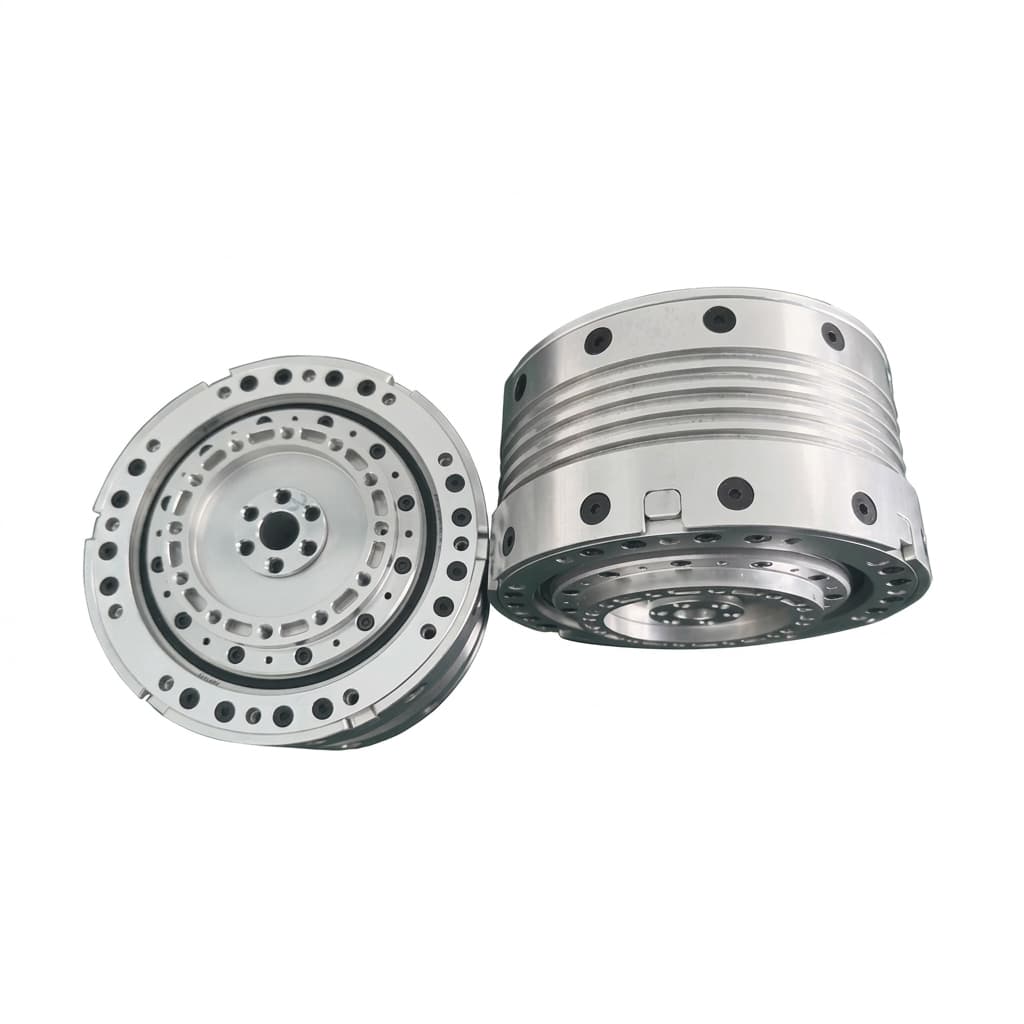
Integrated vs. Discrete Robot Joint Actuators: A 2026 TCO and Procurement Guide
Compare integrated vs. discrete robot joint actuators for 2026 TCO, BOM, labor, supply risk, MTTR, and RFQ decisions for OEM teams.
Key Takeaways
- The "Buy vs. Build" decision for robot joints is shifting: Integrated actuators are now standard for humanoids and cobots, while discrete assemblies remain relevant for high-volume custom form factors.
- Hidden Integration Costs: Procurement teams often underestimate the engineering hours required to align, cable, and tune discrete components. Integrated modules can remove most joint-level assembly and baseline tuning work when the supplier validates the complete module.
- TCO over BOM: While the upfront Bill of Materials (BOM) cost for a discrete assembly can appear lower in early sourcing spreadsheets, the Total Cost of Ownership (TCO) often shifts toward integrated actuators once engineering labor, launch delay, warranty exposure, downtime, and supply chain administration are included.
- Standardization: Purchasing integrated modules allows OEMs to treat the joint as a "black box" with guaranteed performance metrics, pushing the reliability risk back to the Tier 1 supplier.
- Supply Chain Resilience: Relying on one vendor for a complete integrated joint reduces the risk of part shortages compared to sourcing from four different discrete suppliers.
1. The Problem: Chasing the Lowest BOM Cost in 2026
This 2026 guide is written for global OEM engineering, procurement, and supplier-quality teams comparing robot joint actuators for cobots, humanoids, service robots, AMRs, exoskeletons, and compact industrial arms. It is not a universal replacement for application testing: payload, duty cycle, thermal boundary, safety standard, annual volume, and local service model still determine the final sourcing decision.
In 2026, robotics OEMs are under immense pressure to reduce costs. As the market for collaborative robots (cobots), autonomous mobile robots (AMRs), and humanoid platforms scales up, engineering and procurement teams face a critical divergence point when sourcing components for robotic arms and legs: Should we buy a pre-assembled, integrated robot joint actuator, or should we source the motor, reducer, encoder, and driver as discrete components and build it ourselves?
At first glance, buying discrete parts from separate vendors seems like the easiest way to cut initial hardware costs. By selecting a frameless brushless DC (BLDC) motor from Vendor A, a harmonic drive from Vendor B, an absolute encoder from Vendor C, and a servo drive from Vendor D, procurement teams can often negotiate competitive unit prices. In a spreadsheet, the total Bill of Materials (BOM) for this discrete approach can look cheaper than buying a fully integrated joint actuator module.
However, this approach often ignores the massive integration complexity that follows. A robot joint is an electromechanical system where the performance of each component is heavily dependent on the others. A minor misalignment between the motor shaft and the wave generator of the harmonic drive can introduce premature wear, vibration, and backlash. A poorly designed thermal path can cause the motor to overheat the nearby delicate absolute encoder, leading to catastrophic failure in the field.
Procurement teams that focus exclusively on the initial BOM cost frequently find their savings erased by bloated engineering hours, delayed product launches, and high warranty claim rates. In contrast, evaluating the Total Cost of Ownership (TCO) provides a more accurate picture of the true cost of bringing a robot to market.
TCO Method Used in This Guide
Use this article as a procurement screen before RFQ release, not as a final should-cost model. The comparison weighs six cost buckets across prototype, pilot, and the first three years of field operation:
| TCO Bucket | What to Count | Why It Changes the Decision |
|---|---|---|
| Hardware BOM | Motor, reducer, encoder, drive, brake, bearings, connectors, housings | Discrete sourcing can look cheaper before integration cost is added. |
| Mechanical Integration | Custom flanges, shaft support, concentricity control, assembly fixtures | Component-set gearheads and frameless motors move precision assembly work to the OEM. |
| Electrical Integration | Cable routing, shielding, grounding, connector validation, drive cabinet space | Separate motor, encoder, and drive packages add failure points and EMC work. |
| Controls & Calibration | Current loop, velocity loop, position loop, resonance testing, software parameters | Supplier-tuned modules reduce low-level motion commissioning effort. |
| Supply Chain Administration | Supplier qualification, MOQ, lead-time buffering, revision control | One module SKU is easier to manage than multiple synchronized component suppliers. |
| Field Service & Warranty | Fault diagnosis, spare strategy, swap time, root-cause responsibility | Integrated modules simplify replacement; discrete failures require component-level diagnosis. |
2. Defining the Two Approaches: Integrated vs. Discrete
Before diving into the financial analysis, it is essential to clearly define the two procurement strategies.
What is a Discrete Robot Joint Assembly?
A discrete assembly is the traditional approach to building a robot. The OEM purchases individual components and takes full responsibility for integrating them into a functional joint.
- The Components: Frameless or housed motor, gear reducer (planetary, cycloidal, or harmonic), primary and secondary encoders, servo drive/controller, braking mechanism, bearings, and custom machined housings.
- The Responsibility: The OEM's engineering team must design the mechanical housing, ensure precise alignment, route the internal cabling, manage thermal dissipation, and tune the control loops (current, velocity, position) for the specific combination of components.
- The Promise: Maximum flexibility and the lowest theoretical raw material cost.
What is an Integrated Robot Joint Actuator?
An integrated actuator is a "plug-and-play" module that combines all necessary joint components into a single, compact housing provided by a single supplier.
- The Components: Motor, reducer, dual encoders, servo drive, and sometimes brakes and torque sensors, all pre-assembled and factory-sealed.
- The Responsibility: The Tier 1 supplier assumes responsibility for the internal alignment, thermal management, and baseline control loop tuning. The OEM treats the actuator as a "black box" that accepts power and communication signals (e.g., EtherCAT or CANopen) and outputs precise torque and motion.
- The Promise: Accelerated time-to-market, guaranteed performance specifications, and simplified supply chain management, albeit at a higher upfront unit cost.
3. The Cost Structure Comparison: A 2026 Perspective
To make an informed decision, buyers must look at the complete lifecycle of the actuator. The table below breaks down the primary cost and operational differences across seven critical dimensions.
| Evaluation Dimension | Integrated Actuator Module | Discrete Component Assembly | Decision Impact for OEMs |
|---|---|---|---|
| Upfront Hardware (BOM) | Premium pricing (covers integration) | Lower (buying raw components) | Discrete wins on initial capital expenditure. |
| Engineering & Assembly Labor | Minimal (plug-and-play, standard protocols) | High (custom mounts, coupling, complex cabling) | Integrated drastically reduces R&D hours. |
| System Tuning & Calibration | Factory-tuned (guaranteed torque/speed curves) | Requires manual tuning of current/position loops | Integrated accelerates time-to-market. |
| Space & Weight Efficiency | Highly optimized, compact form factor | Bulky, requires extra housing and connectors | Integrated is essential for humanoids/cobots. |
| Supply Chain Complexity | Single SKU, one supplier | Multiple SKUs, staggered lead times | Integrated mitigates component shortage risks. |
| Maintenance & Replacement | Swap the entire module quickly (low MTTR) | High MTTR (diagnose and replace specific part) | Integrated minimizes costly field downtime. |
| Liability & Warranty | Single supplier guarantees joint performance | OEM absorbs risk of component mismatch | Integrated shifts reliability risk to the vendor. |
4. Hidden Integration Costs: Where Discrete Builds Fail
Procurement decisions based solely on purchase price ignore the reality of factory-floor assembly. When opting for discrete components, you are not just paying for a motor and a gearbox. You are paying for a complex engineering project. Here are the hidden costs that frequently derail discrete joint builds:
Custom Machining and Tolerances
In a discrete build, the OEM must design and manufacture the housings and flanges that connect the motor to the reducer. If you are using a frameless motor and a component-set harmonic drive, the machining tolerances required are exceptionally tight—often in the micron range. Manufacturing these custom parts at scale requires expensive CNC machining and rigorous quality control. A single batch of out-of-tolerance housings can lead to eccentric loading on the gear teeth, destroying the reducer in a matter of hours.
Cabling Nightmares and EMI
Routing power and signal cables for separate encoders, drivers, and motors within the tight confines of a robot arm is notoriously difficult. Each connection point is a potential point of failure. Furthermore, placing high-current motor wires near sensitive encoder signal lines increases the risk of Electromagnetic Interference (EMI), which can cause erratic robot behavior. Integrated actuators reduce this exposure by moving much of the internal wiring, shielding, and connector strategy into the supplier-validated module.
Thermal Mismanagement
Robot joints generate significant heat, primarily from the motor coils and the friction within the reducer. In a discrete build, managing this heat is the OEM's problem. Without a unified thermal design, a high-torque motor can easily overheat a nearby delicate absolute encoder, causing thermal drift or outright failure. Integrated actuators are designed as a single thermal system; the housing itself acts as a calibrated heatsink, and the supplier has already validated the thermal boundaries during the design phase.
Control Loop Tuning
Getting a motor, encoder, and driver from three different companies to play nicely together is a software engineering challenge. Engineers must spend weeks manually tuning the PID loops for current, velocity, and position, dealing with the specific resonant frequencies of their custom mechanical assembly. Integrated actuators come with factory-tuned control parameters optimized for that specific combination of hardware, allowing software engineers to focus on higher-level kinematics and AI path planning rather than low-level motor control.
5. Supply Chain Resilience and Sourcing Strategy
In the post-pandemic supply chain environment of 2026, resilience is just as important as unit cost. Managing a discrete joint assembly means managing a fragile supply web.
Imagine building a 6-axis robotic arm using discrete components. Each joint requires a motor, a gearbox, an encoder, and a drive. That is 24 distinct component supply chains to manage per robot. If the encoder supplier experiences a 12-week delay due to semiconductor shortages, production halts, even if the motors and gearboxes are sitting in the warehouse. The administrative burden of tracking multiple SKUs, managing varying minimum order quantities (MOQs), and handling disparate lead times requires significant procurement headcount.
By standardizing on integrated actuators, the procurement team manages just one SKU per joint. The burden of sourcing the sub-components, managing sub-tier supplier quality, and buffering inventory shifts entirely to the Tier 1 actuator manufacturer. If there is a component shortage, it is the actuator supplier's responsibility to find an alternative that meets the module's guaranteed performance specifications. This streamlined approach dramatically reduces the risk of line-down situations and lowers the administrative overhead for the OEM.
6. Maintenance, Warranty, and MTTR
The Total Cost of Ownership extends far beyond the factory floor; it includes the operational life of the robot in the hands of the end-user. For industrial buyers, uptime is paramount. When a robot goes down, the cost is measured in lost production revenue, which can dwarf the initial cost of the robot itself.
The MTTR Advantage
Mean Time To Repair (MTTR) is a critical metric for end-users. When a joint fails in a discrete assembly system, field service technicians must first diagnose which specific component failed—was it the encoder, the drive, or the motor? Once diagnosed, they must disassemble the joint, replace the faulty part, reassemble the custom housing, and potentially recalibrate the system. This process can take hours and requires highly skilled technicians.
With an integrated actuator, the diagnostic and repair process is radically simplified. If joint #3 fails, the technician simply unbolts the entire module, unplugs the single communication/power cable, bolts on a new module, and plugs it in. The entire swap can often be completed in under 30 minutes, minimizing production downtime. The faulty module is then sent back to the manufacturer for refurbishment or failure analysis.
Shifting the Liability
In a discrete setup, warranty claims are a gray area. If the gear reducer fails prematurely, the gearbox manufacturer might blame the OEM for poor alignment, while the OEM might blame the motor manufacturer for excessive vibration. Proving fault is difficult and time-consuming.
When you purchase an integrated actuator, there is a single accountable supplier for the module. The supplier provides a unified warranty for the entire assembly. If the module fails to deliver the promised torque, speed, backlash, sealing, or accuracy within the agreed warranty conditions, the warranty conversation is tied to one module specification rather than a dispute across separate motor, reducer, encoder, and drive vendors.
7. TCO Procurement Checklist for Robot Joints
Before sending out an RFQ for your next robotic platform, use this checklist to determine if your application truly warrants a discrete build or if you should standardize on integrated actuators.
- Calculate True Labor: Have we modeled the engineering hours required to design custom housings and tune control loops for a discrete setup? Have we factored in the fully burdened cost of our mechanical and software engineers?
- Assess Supply Chain Resilience: Can our purchasing team manage 4 different vendors (motor, gear, driver, encoder) with varying lead times and MOQs without delaying SOP?
- Define Volume Thresholds: Are we building fewer than 5,000 units a year? If yes, integrated modules usually deserve first-pass evaluation because tooling, fixtures, calibration scripts, and supplier quality work for a discrete build may not amortize quickly. At higher annual volumes, run a formal make-versus-buy model before deciding.
- Evaluate MTTR Requirements: Does the end-user require a Mean Time To Repair (MTTR) under 30 minutes to minimize line-down costs? If yes, modular/integrated swapping should be evaluated early because component-level diagnosis can become the dominant downtime driver.
- Review Space Constraints: Does the robot joint have strict envelope constraints (e.g., a humanoid shoulder or a compact cobot wrist)?
- Analyze Warranty Risk: Is our company prepared to absorb the liability and diagnostic costs if a discrete joint fails in the field due to component mismatch?
8. Visual Decision Flow: Buy vs. Build
To help align engineering and procurement teams, we have developed the following decision matrix. Use this flow to quickly determine the optimal path for your next project.
9. Application Boundaries: When NOT to use Integrated Modules
While integrated actuators dominate the cobot and humanoid sectors, there are clear application boundaries where a discrete approach remains technically and financially valid:
- Ultra-low Cost Toys & Educational Robotics: In applications where precision backlash, high torque density, and multi-year lifespan are not critical, sourcing cheap discrete components (e.g., standard hobby servos and plastic gears) makes sense.
- Highly Specialized Harsh Environments: In environments involving extreme radiation, vacuum, or ultra-high temperatures, a highly specialized motor might survive, but the sensitive driver electronics cannot. In these cases, the motor and gearbox must be placed in the danger zone, while the electronics are mounted far away in a shielded cabinet. Integrated actuators, which house the electronics alongside the motor, cannot be used here.
- Massive Payload Industrial Robotics: Traditional heavy-duty 6-axis industrial arms (handling payloads over 500 kg) still frequently utilize separate large AC servomotors and massive cycloidal gearboxes. At this physical scale, the size and weight benefits of integration are negligible, and the modular approach allows for easier handling of massive individual components during assembly.
10. Frequently Asked Questions (FAQ)
Q: Do integrated actuators cost more upfront than discrete components? A: Usually, yes. Unit-for-unit, an integrated actuator often carries a premium over the raw sum of unassembled discrete parts. However, that premium covers factory assembly, precision alignment, housing design, control loop tuning, and a unified warranty. When engineering labor, launch delay, fixture cost, and field service exposure are included, the integrated module can become the lower-risk TCO choice for many prototype, pilot, and mid-volume programs.
Q: What happens if an internal component (like an encoder) fails in an integrated joint? A: In most professional and industrial environments, the standard procedure is to swap out the entire integrated module to minimize production downtime. The exact service time depends on the robot layout, access clearance, connector design, and commissioning process. The failed unit is then sent back to the manufacturer for refurbishment or failure analysis, rather than the end-user attempting field repairs on delicate internal components.
Q: Are communication protocols standardized for integrated actuators, or will I be locked into a proprietary ecosystem? A: Leading manufacturers offer standard, open protocols such as EtherCAT, CANopen, and RS485. This makes it relatively straightforward to integrate these modules into standard ROS/ROS2 environments, industrial PLCs, or proprietary control systems, mitigating the risk of vendor lock-in at the software level.
Q: Can integrated actuators be customized for specific applications? A: Yes. While they are sold as standard SKUs, most Tier 1 suppliers offer customization options for OEM buyers ordering in volume. This can include custom connector types, specific gear ratios, modified firmware parameters, or tailored form factors to perfectly match the robot's design.
11. Sources & References
To keep the comparison auditable, this guide uses specific technical sources rather than homepage-level citations:
- CubeMars integrated actuator comparison - Defines integrated electric actuators as motor, driver, encoder, and reducer assemblies, and explains why supplier-level matching can reduce user-side integration and debugging complexity. cubemars.com
- Harmonic Drive component set engineering data - Shows why reducer component sets require OEM-side design, assembly, lubrication, sealing, bearing support, and wave-generator checks before they can be treated as production-ready robot joints. harmonicdrive.net PDF
- EtherCAT Technology Group overview - Documents EtherCAT as a real-time Industrial Ethernet technology disclosed in IEC standards, supporting the protocol discussion for integrated actuator modules. ethercat.org
- CAN in Automation higher-layer protocol overview - Documents CANopen and CiA 301 as standardized higher-layer protocols commonly used in industrial motion and embedded control. can-cia.org
- Multnomah County TCO and life-cycle costing guidance - Defines Total Cost of Ownership as costs incurred throughout the lifetime of owning or using an asset, beyond the original purchase price. multco.us
12. Next Steps for Procurement Teams
Stop wasting highly paid engineering hours on mechanical alignment, custom flange design, and control loop debugging. By shifting your sourcing strategy to high-performance integrated modules, your OEM can accelerate time-to-market, improve product reliability, and drastically lower the Total Cost of Ownership for your robotic platforms.
Explore our Selection Guide to size your next joint architecture, or directly submit your parameters using our RFQ Template to get started. For custom volume pricing and engineering alignment, reach out via our Contact / RFQ page.
Author

Categories
More Posts
Hollow Shaft vs Solid Shaft Robot Joint Actuators: A Procurement and Engineering Guide
An in-depth analysis of hollow vs. solid shaft robot joint actuators. Learn how internal cable routing impacts torque density, sealing, cost, and procurement strategy.
TCO Analysis for Robot Joint Actuators: Hidden Costs Beyond the BOM
Use this 2026 robot joint actuator TCO guide to price integration, tuning, yield, warranty, downtime, spares, and supplier risk before issuing an RFQ.
Robot Joint Actuator RFQ Template: 25 Fields Buyers Should Send
A buyer-grade RFQ template with 25 mandatory fields, supplier red flag checklist, complete fill-in example, quote-comparison matrix, and timeline expectations to reduce rework and speed supplier evaluation.