
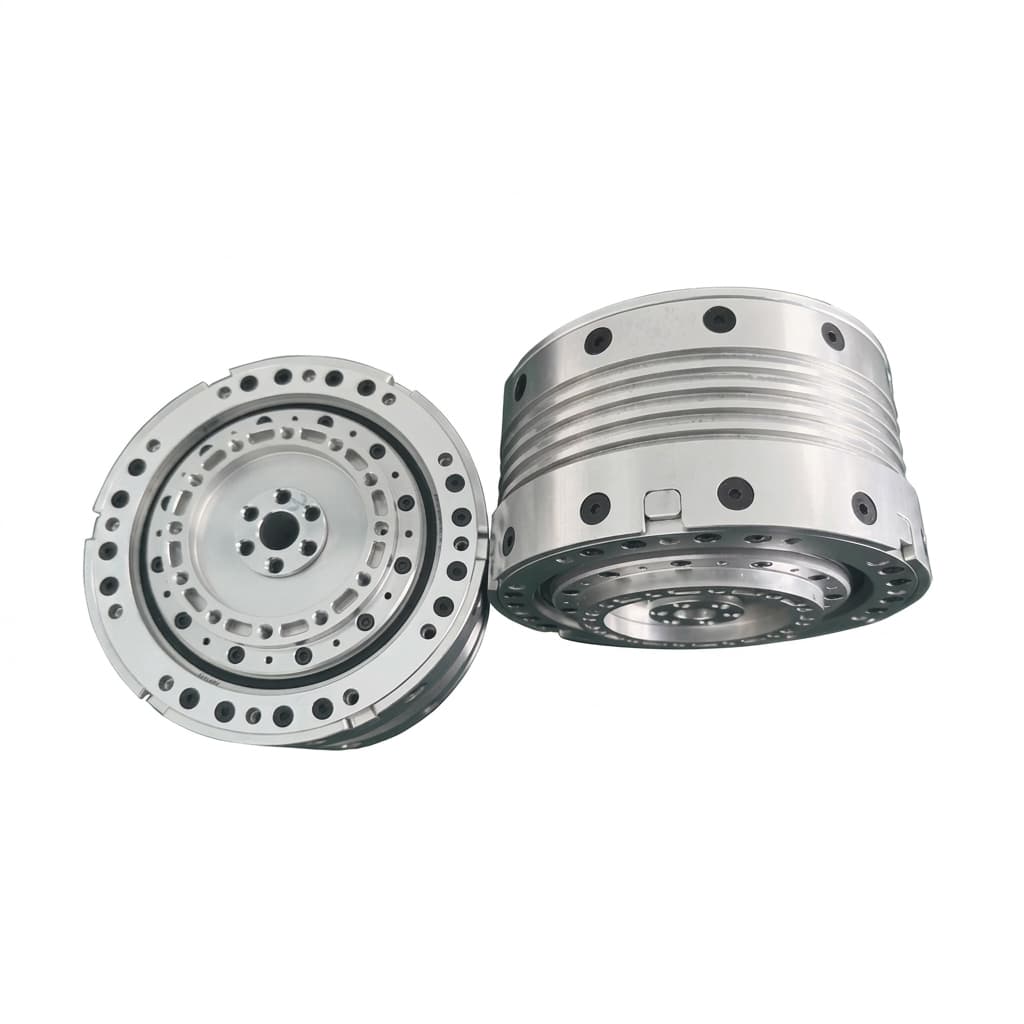
Robot Joint Actuator Selection Guide for OEM Buyers (2026)
A practical selection framework covering reducer type comparison, torque-speed reality checks, backlash/stiffness targets, thermal margins, and RFQ-ready data for robot joint actuator programs.
Key Takeaways
- Freeze your minimum input dataset (8 fields) before comparing any supplier. Skipping this step causes 70%+ of RFQ rework.
- Use the 0.75× continuous torque rule to maintain operating margin: your required duty must be ≤75% of the supplier's stated continuous capability.
- Reducer selection (harmonic vs cycloidal vs planetary) is the single highest-impact architecture decision — it determines backlash, shock tolerance, cost tier, and actuator envelope.
- Always require suppliers to disclose backlash test conditions (load state, reversal method, sample count). Catalog numbers without test context are not comparable.
Who This Guide Is For
This guide is written for buyer-side engineers and sourcing teams who need to shortlist robot joint actuators without repeated quote loops.
If your team is evaluating multiple suppliers, the fastest way to improve decision quality is to align on measurable acceptance criteria before asking for final price.
Step 1: Lock Input Data Before Comparing Models
Do not compare suppliers before you freeze the minimum input dataset.
| Input Field | Minimum Requirement | Why It Matters |
|---|---|---|
| Joint axis function | Shoulder / elbow / wrist / hip / knee | Changes torque-speed duty and envelope constraints |
| Continuous torque target | Nm at target RPM (not only stall) | Prevents false pass on peak-only marketing data |
| Peak torque duty | Duration and repeat frequency | Impacts thermal design and overload strategy |
| Gear ratio expectation | Candidate ratio range | Directly changes output speed, backlash, and efficiency |
| Backlash ceiling | Arcmin limit at load condition | Defines positioning accuracy and control behavior |
| Bus voltage and protocol | Voltage, EtherCAT/CAN/other | Determines driver/integration compatibility |
| Thermal boundary | Ambient + enclosure condition | Avoids open-air test assumptions |
| Mechanical interface | Flange, shaft, connector revision | Reduces sample mismatch and schedule rework |
Step 2: Choose Reducer Type First
The reducer is the single most important architecture decision. It determines backlash, shock tolerance, cost, and actuator envelope. Choose the wrong type and no amount of motor optimization will compensate.
Harmonic vs Cycloidal vs Planetary — Decision Matrix
| Parameter | Harmonic Drive | Cycloidal Reducer | Planetary Gearbox |
|---|---|---|---|
| Backlash | < 1 arcmin (near-zero) | 1–3 arcmin | 3–8 arcmin |
| Torque density | High | Very high | Medium |
| Shock/impact tolerance | Low — wave generator is fragile | High — robust against transient loads | Medium |
| Efficiency | 75–85% | 85–92% | 90–95% |
| Cost tier | High | Medium-high | Medium |
| Noise level | Low | Medium | Higher at high ratios |
| Hollow shaft availability | Common | Limited | Limited |
| Best application | Humanoid upper-body joints, cobots, medical robots | Quadruped legs, heavy-duty industrial joints | Industrial retrofit, cost-sensitive multi-axis |
Buyer rule of thumb: If your joint requires < 3 arcmin backlash and operates in a controlled environment (no shock), start with harmonic. If shock loads are expected (leg joints, mobile robots), default to cycloidal. If cost is the primary constraint and 5+ arcmin backlash is acceptable, evaluate planetary first.
Our product families cover all three architectures:
- Integrated Harmonic Joint Actuator — 5–80 Nm continuous, < 1 arcmin
- High-Torque Cycloidal Joint Actuator — 50–200 Nm continuous, shock-rated
- Compact Planetary Joint Module — cost-optimized, 10–120 Nm class
Step 3: Use a Torque-Speed Reality Check
A frequent failure is selecting based on holding torque only.
Use this buyer rule:
required continuous torque at target speed <= 0.75 × supplier stated continuous capability
This keeps operating margin for heat, transient loads, and assembly deviation.
Quick sanity example
- Required duty:
75 Nm @ 45 RPM - Supplier continuous claim:
90 Nm @ 45 RPM - Margin check:
75 / 90 = 0.83-> too tight
In this case, either increase actuator class or reduce duty concentration by motion profile optimization.
Sizing reference by application
| Application | Typical Continuous Torque Range | Typical Speed Range | Sizing Note |
|---|---|---|---|
| Humanoid shoulder | 20–50 Nm | 10–30 RPM | High precision, moderate load |
| Humanoid hip/knee | 50–120 Nm | 5–20 RPM | High load, shock events during gait |
| Cobot elbow | 15–40 Nm | 20–60 RPM | Moderate speed, frequent reversal |
| Quadruped hip | 40–80 Nm | 15–45 RPM | Dynamic duty, thermal accumulation |
| Industrial wrist | 5–20 Nm | 30–90 RPM | High speed, precision path |
Step 4: Match Backlash and Stiffness to Application Class
| Application Class | Typical Backlash Control Priority | Typical Stiffness Priority | Buyer Note |
|---|---|---|---|
| Collaborative arm | Medium-high | Medium | Balance safety behavior and repeatability |
| Humanoid joint | High | High | Dynamic gait stability is sensitive to compliance drift |
| Industrial articulated arm | High | High | Process accuracy and cycle repeatability dominate |
| Quadruped leg module | Medium | Very high | Shock and transient load paths dominate reliability |
Ask suppliers to state backlash test condition explicitly:
- load state;
- direction reversal method;
- measured unit and sample count.
Warning: Backlash values without test condition disclosure are not comparable across suppliers. A supplier claiming "< 1 arcmin" measured at no-load with a single-direction approach is not equivalent to "< 1 arcmin" measured under 20% rated load with full reversal. Always request the test protocol.
Step 5: Thermal Review Before RFQ Lock
Thermal issues usually appear after prototype integration, not in catalog comparison.
A useful screening metric is the Motor Constant (Km), measured in Nm/√W. Km indicates how efficiently the motor converts electrical power into torque within a given thermal budget. When comparing actuators of similar size, the higher Km unit will run cooler at the same torque output — this directly impacts continuous duty rating in enclosed installations.
Use this checklist before quote finalization:
- confirm continuous duty profile per axis;
- confirm enclosure airflow assumptions;
- request temperature-rise evidence under comparable duty;
- align maximum winding/housing thresholds used for pass/fail;
- compare Km values when evaluating actuators of similar physical size.
Visual Decision Flow
Step 6: Decide With a Weighted Matrix
| Criterion | Weight (Example) | Supplier A | Supplier B | Supplier C |
|---|---|---|---|---|
| Continuous torque margin | 25% | 8 | 6 | 7 |
| Backlash/stiffness fit | 20% | 7 | 8 | 6 |
| Thermal evidence quality | 20% | 6 | 8 | 5 |
| Interface fit risk | 15% | 9 | 6 | 7 |
| Lead time realism | 10% | 7 | 7 | 8 |
| Change control maturity | 10% | 8 | 6 | 6 |
Use a single evaluation sheet shared by engineering and sourcing. This prevents parallel decisions based on different assumptions.
Common Buyer Mistakes
- Sending RFQ with only peak torque and no duty context.
- Comparing backlash values without test condition disclosure.
- Ignoring thermal boundary until prototype stage.
- Locking price before locking interface revision.
- Accepting "equivalent model" claims without measurable acceptance criteria.
- Over-sizing actuator by 2x+ out of caution — this increases joint weight, system inertia, and cost without meaningful safety benefit. The 0.75× rule above provides sufficient margin.
What to Send in First RFQ Email
At minimum include:
- target axis and motion profile;
- continuous/peak torque at RPM;
- backlash limit and thermal boundary;
- protocol + electrical window;
- prototype quantity and target SOP timeline.
If you need a reusable format, use our full RFQ template guide with 25 mandatory fields.
After supplier shortlisting, plan your validation using the 12-gate prototype-to-MP execution model.
For direct technical alignment, use Contact / RFQ.
Author

Categories
More Posts
Hollow Shaft vs Solid Shaft Robot Joint Actuators: A Procurement and Engineering Guide
An in-depth analysis of hollow vs. solid shaft robot joint actuators. Learn how internal cable routing impacts torque density, sealing, cost, and procurement strategy.
Prototype to Mass Production: 12 Gate Plan for Joint Actuators
A 12-gate execution model for robot joint actuator programs covering prototype validation, CTQ control, compliance file readiness, and production-release criteria with timeline estimates and cost-of-failure analysis.
TCO Analysis for Robot Joint Actuators: Hidden Costs Beyond the BOM
Use this 2026 robot joint actuator TCO guide to price integration, tuning, yield, warranty, downtime, spares, and supplier risk before issuing an RFQ.