
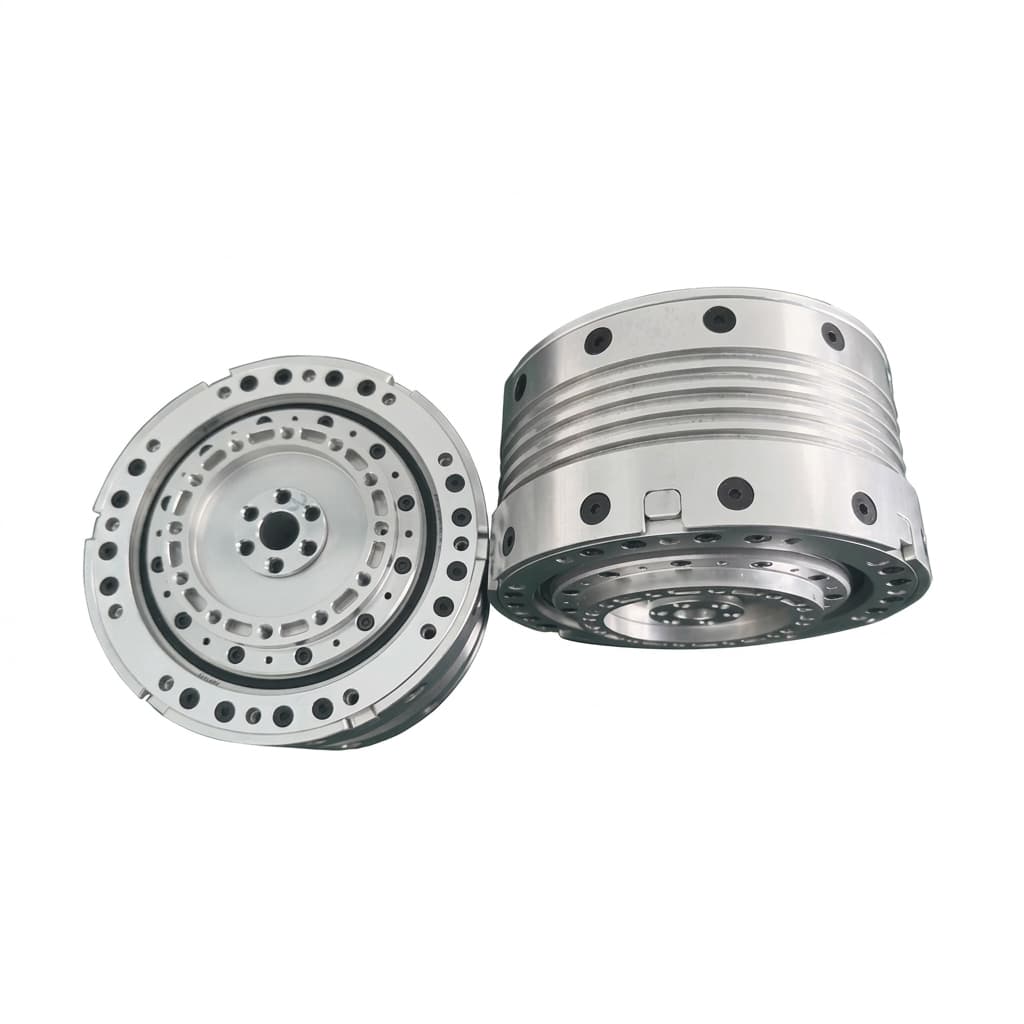
Hollow Shaft vs Solid Shaft Robot Joint Actuators: A Procurement and Engineering Guide
An in-depth analysis of hollow vs. solid shaft robot joint actuators. Learn how internal cable routing impacts torque density, sealing, cost, and procurement strategy.
Key Takeaways
- Cable Management is the Primary Driver: The decision to use a hollow shaft actuator is almost exclusively driven by the need for internal cable routing. Routing power, data, and pneumatic lines through the center of rotation eliminates external wire snags, reduces wear, and enables infinite rotation.
- The Cost Premium: In early RFQ screening, hollow shaft joint actuators often need a 30% to 60% budget premium over comparable solid shaft models because of specialized large-diameter bearings, complex encoder mounting, and hollow reducer geometries. Treat this as a sourcing estimate, not a guaranteed catalog multiplier.
- Torque Density Trade-offs: For a given outer diameter, a hollow shaft reduces the available volume for electromagnetic windings, leading to a slight drop in torque density. Engineers must size up the motor frame, reduce the duty cycle, or optimize thermal management to compensate.
- Sealing Challenges: Achieving high ingress protection (IP67 or IP68) is significantly harder and more expensive in hollow shaft architectures because there are two rotating sealing surfaces (inner bore and outer casing) instead of just one.
- Procurement Focus: Sourcing teams must lock in the required "bore diameter" during the Engineering Verification Test (EVT) phase. Late changes to cable bundle sizes can invalidate the entire joint actuator selection.
Scope, Date, and Decision Boundary
This guide was last updated on 2026-07-24 for global OEM procurement and engineering teams evaluating robot joint actuators for cobots, humanoid robots, quadrupeds, mobile manipulators, and compact industrial arms. It is intended for architecture selection before RFQ release, not for final safety validation, certification, or production release.
Use a hollow shaft actuator when downstream cable routing, pneumatic routing, optical fiber, slip-ring integration, or continuous joint rotation is a real system requirement. Use a solid shaft actuator when the joint can tolerate external harness routing and the priorities are cost, torque density, supplier availability, and simpler sealing. The cost and torque ranges below are screening bands based on typical actuator program trade-offs; final selection still requires supplier datasheets, derating curves, interface drawings, environmental test plans, and end-of-line acceptance criteria.
For adjacent sizing work, compare this guide with our robot joint actuator product families and technical datasheet pack before sending the RFQ.
The Cable Routing Crisis in Modern Robotics
As robots transition from structured factory environments to dynamic, unstructured settings (like logistics warehouses, hospitals, and human environments), their physical architectures are becoming vastly more complex. A multi-axis robotic arm or a bipedal humanoid robot requires a massive nervous system of cables to function.
In traditional industrial robotic arms, cables are often strapped to the outside of the links. While this is cost-effective, it introduces several severe failure modes:
- Snagging and Catching: External cables can catch on the environment or the robot's own structure.
- Fatigue and Wear: Cables bending across a joint's exterior experience high localized stress, leading to wire fatigue and eventual communication or power loss.
- Restricted Range of Motion: External cables limit the joint's ability to rotate continuously (infinite rotation is impossible).
To solve this, modern robotic design mandates internal cable routing. This is where the hollow shaft robot joint actuator becomes an indispensable component. By featuring a central bore that passes entirely through the motor, encoder, and gearbox, it allows the entire cable bundle to pass through the exact center of rotation. Because the cables twist axially rather than bending tangentially, their lifespan is extended by orders of magnitude, and the robot achieves a sleek, human-like form factor.
However, choosing between a hollow shaft and a solid shaft is not merely a feature checklist item—it fundamentally alters the mechanical performance, thermal behavior, and unit economics of the robot.
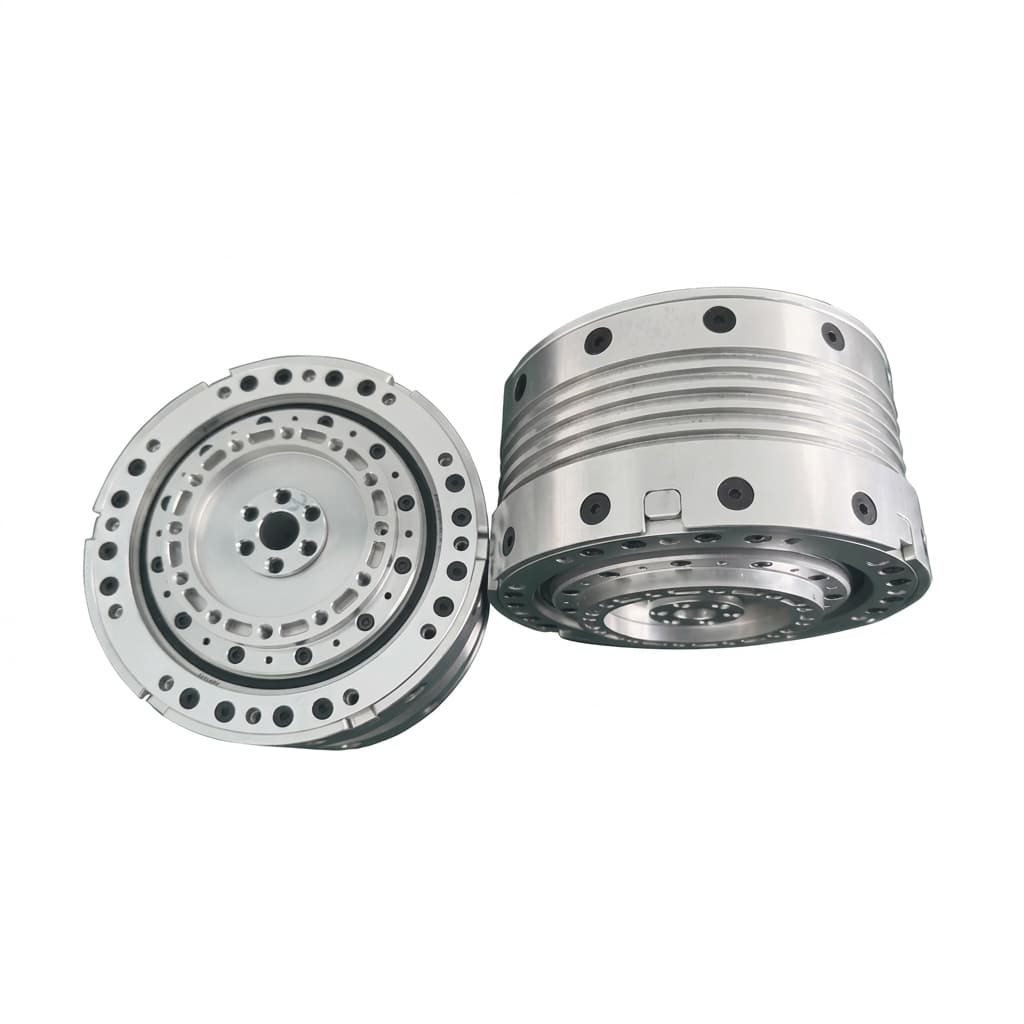
Core Architectural Differences
To understand the procurement and engineering implications, we must first look at the architectural differences inside the actuator housing.
Solid Shaft Actuators
In a solid shaft actuator, the motor rotor is a solid cylinder (or a tube with a very small, non-usable center). The encoder is typically mounted at the rear, directly on the end of the shaft. The torque from the motor is transmitted directly into the input stage of the reducer (such as the wave generator in a harmonic drive or the sun gear in a planetary gearbox).
- Advantages: Maximum space utilization for electromagnetic windings (high torque density), simplified bearing arrangements, single primary sealing point, lower manufacturing cost, and massive supplier availability.
- Disadvantages: All external connections to downstream joints must bypass the actuator, requiring external routing.
Hollow Shaft Actuators
In a hollow shaft actuator, the central axis is a large hollow tube. The motor rotor is built around this tube. The encoder cannot be mounted in the center, so it must be a ring-style encoder (magnetic or optical) with a large inner diameter. The reducer must also feature a hollow through-hole (e.g., a hollow-type harmonic drive or a specialized cycloidal stage).
- Advantages: Complete internal cable concealment, protection from environmental hazards, enhanced aesthetic and functional form factor, and capability for continuous 360-degree+ rotation without cable wrapping limits.
- Disadvantages: Complex assembly, higher component count, larger diameter bearings required, dual dynamic seals needed for IP ratings, and a significant cost penalty.
Engineering Trade-offs in Joint Actuator Design
When an engineering team requests a hollow shaft actuator, the sourcing team must understand the downstream impacts of this choice. The trade-offs are significant.
1. Torque Density and Outer Diameter (OD)
Because the center of the actuator is "empty space" reserved for cables, the electromagnetic components (stator and rotor) are pushed outward. To achieve the same torque as a solid shaft motor, a hollow shaft motor must either:
- Be longer (increasing the axial length of the joint).
- Have a larger outer diameter (OD). If the robot's physical envelope is strictly constrained, moving to a hollow shaft might result in a 10-15% reduction in continuous torque capability.
2. Reducer Selection Constraints
Not all gearboxes are easily made hollow.
- Harmonic Drives: Readily available in hollow configurations (e.g., cup-type or hat-type flexsplines with hollow wave generators). These are the standard for high-precision, low-backlash cobot joints.
- Cycloidal / RV Reducers: Can be engineered with a hollow center, but it significantly complicates the eccentric shaft arrangement.
- Planetary Gearboxes: Very difficult to make truly hollow through the center because the sun gear naturally occupies the central axis. Specialized hollow planetary designs exist but are expensive and less common.
3. Encoder Complexity
Solid shaft actuators typically use simple, cheap, end-of-shaft magnetic encoders (often off-the-shelf ICs). Hollow shaft actuators require large-diameter ring encoders. These can be optical (expensive, fragile, high precision) or multi-pole magnetic rings (robust, moderate cost, complex calibration). This alone can add $50 to $150 to the Bill of Materials (BOM) cost per joint.
4. Thermal Dissipation
The hollow bore acts as a thermal insulator in the center of the motor. While the outer casing can dissipate heat to the environment or the robot's metal links, the inner rotor has a harder time shedding heat. Furthermore, if high-power cables are routed through the center bore, they can add to the thermal load or be damaged if the motor runs too hot. Careful thermal derating is required.
5. Ingress Protection (IP Rating)
For outdoor robots, agricultural robots, or washdown environments, IP67 or IP68 ratings are critical. A solid shaft actuator only needs a dynamic seal on the output flange and static O-rings on the casing. A hollow shaft actuator requires dynamic sealing on both the outer rotating flange AND the inner rotating bore. Ensuring watertight integrity on two concentric rotating surfaces over thousands of hours of operation is a severe engineering challenge.
If your shortlist includes sealed hollow joints, request a drawing that identifies every dynamic and static sealing interface before EVT. The same review should include cable thermal rise inside the bore, connector installation order, and whether the supplier can provide CAD/STEP files for harness-envelope checks. Our CAD/STEP model pack outlines the evidence buyers should request before a design freeze.
Visualizing the Structural Differences
Comprehensive Comparison Table
When evaluating which architecture to adopt for a new robot arm or leg joint, use this comparison matrix to align your engineering and sourcing teams.
| Evaluation Dimension | Solid Shaft Actuator | Hollow Shaft Actuator | Procurement Impact |
|---|---|---|---|
| Cable Management | External routing required | Internal passage through bore | Internal reduces field failures and warranty claims. |
| Torque Density (Nm/kg) | Very High (Optimized volume) | Medium-High (Volume lost to bore) | May require moving to a larger frame size for hollow. |
| Relative Cost Tier | Baseline (1.0x) | Premium (1.3x - 1.6x) | Major BOM impact. Requires justification via TCO. |
| Supplier Availability | Ubiquitous (Hundreds of sources) | Specialized (Fewer qualified vendors) | Higher supply chain risk; requires careful second-sourcing. |
| Ingress Protection | Easy to achieve IP67/IP68 | Difficult to maintain dynamic sealing | Increases NRE and testing costs for outdoor applications. |
| Encoder Technology | Low-cost on-axis magnetic chip | High-cost off-axis ring encoder | Drives up component cost and assembly calibration time. |
| Bearing Complexity | Standard deep groove/angular | Large inner-diameter thin-section | Thin-section bearings are expensive and sensitive to shock. |
| Continuous Rotation | Limited by cable twist/wrap | Infinite 360°+ capability | Essential for specific features like continuous panning. |
Procurement & Sourcing Strategy
If your engineering team determines that hollow shaft actuators are mandatory, the procurement strategy must shift to accommodate a more constrained supply chain.
1. Vendor Qualification
Not all motor manufacturers can produce reliable hollow shaft modules. The integration of the large-diameter encoder, the hollow wave generator, and the thin-section bearings requires extreme precision. Misalignment in assembly leads to premature bearing failure or encoder reading errors. Prioritize suppliers who offer fully integrated joint modules rather than buying the motor, reducer, and encoder separately and attempting to assemble them in-house. For precision arm projects, start with the integrated harmonic joint actuator family and verify whether the bore diameter, brake option, encoder output, and mounting bolt circle fit the robot link geometry.
2. Second-Sourcing Challenges
Because hollow shaft geometries (specifically the bore diameter and the mounting bolt circles) are not deeply standardized across the industry, switching suppliers mid-production often requires changing the structural metal links of the robot. To mitigate this, establish a multi-source agreement during EVT, ensuring that at least two suppliers can match the critical interface dimensions.
3. Total Cost of Ownership (TCO) Justification
Procurement will immediately notice the 30-60% price premium of hollow joints. To justify this, evaluate the TCO. External cables require custom harnesses, cable carriers, frequent replacement, and introduce the risk of catastrophic field failure if a cable catches and breaks. For collaborative robots (cobots) and humanoids, the aesthetic and safety benefits of hidden cables often easily justify the premium.
Hollow Shaft Actuator Selection Checklist (RFQ Inputs)
Before sending a Request for Quote (RFQ) to a joint actuator supplier, ensure your engineering team has frozen the following variables. Changing the bore diameter late in the process will reset the entire quote and lead time.
- Minimum Bore Diameter (mm): Calculate the exact diameter of the cable bundle (power, data, pneumatic) including the connectors if they must pass through after assembly. Add a 10-20% clearance margin.
- Continuous Torque (Nm) at Target RPM: Do not just specify stall torque. Specify the continuous running torque.
- Peak Torque (Nm): Identify shock loads or emergency stop requirements.
- Operating Voltage (V) & Protocol: e.g., 48VDC, EtherCAT, CANopen.
- Backlash Tolerance (arcmin): Usually < 1 arcmin for precision arms, or 3-5 arcmin for legs.
- IP Rating Requirement: Specify if IP65, IP67, etc. is required, and clarify the test conditions.
- Operating Temperature Range: Remember that internal cables will restrict airflow through the bore.
- Maximum Outer Diameter (mm): The strict boundary for the robot's physical envelope.
Frequently Asked Questions (FAQ)
1. Can I use a hollow shaft actuator for every joint in a robot arm?
While possible, it is usually not cost-effective. Typically, the base, shoulder, and elbow joints utilize hollow shafts to route cables up the arm. The final wrist joints or end-effector actuators may use solid shafts if there are no further components downstream requiring cable connections.
2. How much clearance do I need in the hollow bore for my cables?
Always leave at least 15-20% free space in the bore. Packing the bore too tightly prevents the cables from flexing naturally during rotation, which can lead to friction, heat buildup, and eventual insulation failure.
3. Are hollow shaft actuators weaker than solid shaft actuators?
Not necessarily "weaker," but they have a lower torque density. To output the same torque as a solid shaft motor, a hollow shaft motor will generally need a larger outer diameter.
4. Do hollow shaft joints require special drivers or controllers?
The driver electronics are fundamentally the same (standard servo controllers). However, the encoder feedback is different. Because hollow joints use ring encoders, ensure your chosen driver is compatible with the specific output (e.g., BiSS-C, SSI, or incremental ABZ) of the high-resolution ring encoder.
5. Why is IP67 so difficult for hollow shaft actuators?
An IP67 rating requires surviving immersion in water. A hollow shaft has a through-hole, meaning water can potentially enter between the rotating inner bore and the stationary housing, as well as the outer rotating flange. Sealing two dynamic rotational interfaces adds significant friction and complexity.
6. Can I retrofit a solid shaft robot to use hollow shaft actuators?
Retrofitting is generally a complete redesign. The mounting patterns, outer diameters, and structural connections of the robot links will all need to change to accommodate the larger geometry and internal cable paths of the hollow actuators.
Sources and References
- Harmonic Drive FBS hollow-shaft gear units: Official hollow-shaft reducer reference for compact precision gear units where through-axis cabling or media routing is required. Harmonic Drive FBS hollow-shaft gear units
- CubeMars product catalog: Official vendor catalog for integrated robotic actuators, including hollow-shaft actuator families used in legged and humanoid robot platforms. CubeMars robotics actuator catalog
- WITTENSTEIN hollow shaft actuators: Official application reference for servo actuators with a large hollow shaft used to route cables, media, or additional shafts through the rotation axis. WITTENSTEIN hollow shaft actuators
- Robot Joint Actuator engineering resources: Internal buyer evidence checklist for datasheets, CAD/STEP files, compliance assumptions, and RFQ-stage documentation. Engineering resources
For project-specific sizing or to request a 3D CAD model of our hollow shaft joint modules, review our integrated harmonic joint actuator and then contact our engineering team.
Author

Categories
More Posts
Robot Joint Actuator RFQ Template: 25 Fields Buyers Should Send
A buyer-grade RFQ template with 25 mandatory fields, supplier red flag checklist, complete fill-in example, quote-comparison matrix, and timeline expectations to reduce rework and speed supplier evaluation.
Robot Joint Actuator Selection Guide for OEM Buyers (2026)
A practical selection framework covering reducer type comparison, torque-speed reality checks, backlash/stiffness targets, thermal margins, and RFQ-ready data for robot joint actuator programs.
Prototype to Mass Production: 12 Gate Plan for Joint Actuators
A 12-gate execution model for robot joint actuator programs covering prototype validation, CTQ control, compliance file readiness, and production-release criteria with timeline estimates and cost-of-failure analysis.