
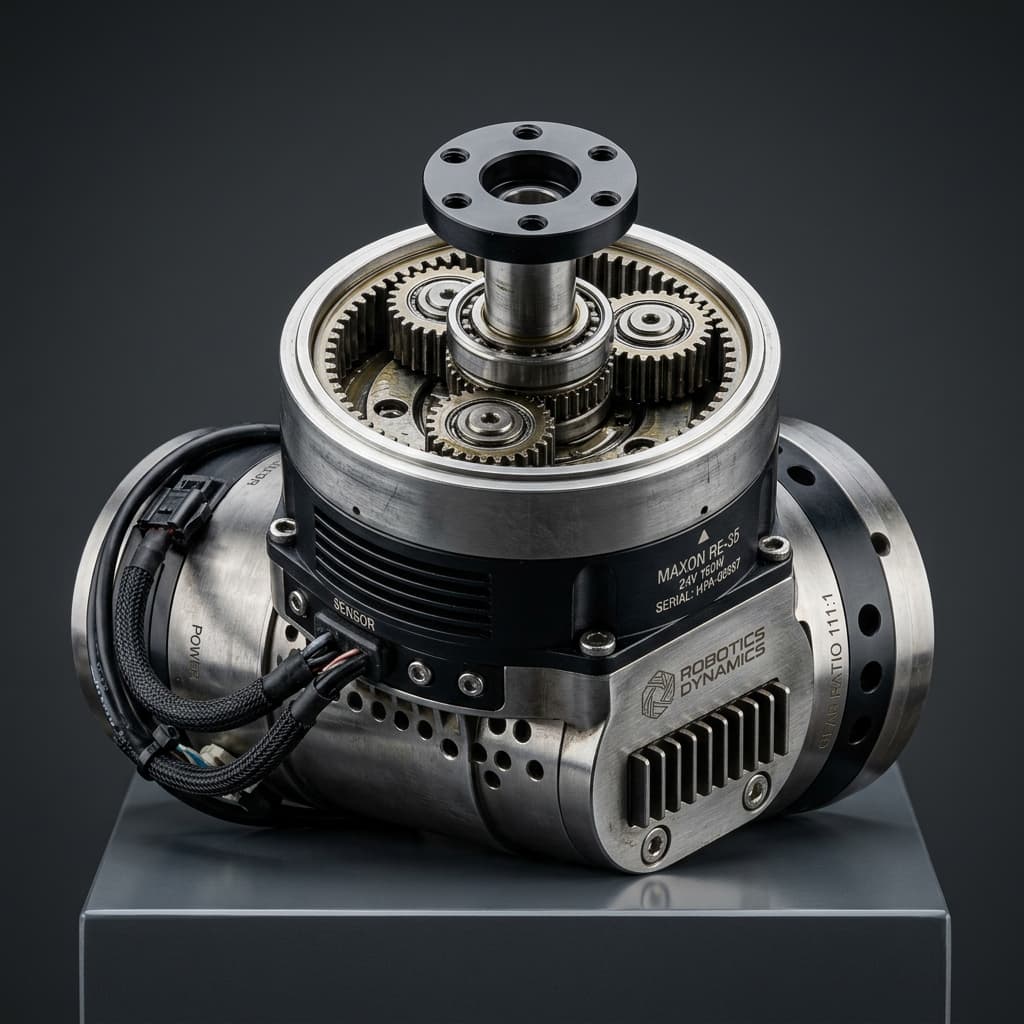
Functional Safety (SIL 3 / PL e) in Robot Joint Actuators: A 2026 Guide
Use this 2026 guide to evaluate SIL 3 / PL e robot joint actuators, STO/FSoE requirements, procurement checks, and RFQ questions for global cobot OEMs.
Key Takeaways
- Scope: This guide is written for global OEM procurement and engineering teams evaluating joint-level functional safety in 2026; it is not a substitute for system-level risk assessment or certification-body review.
- As human-robot collaboration scales up in 2026, functional safety is no longer just a system-level afterthought—it is a critical requirement at the joint actuator level.
- Safe Torque Off (STO), dual-channel encoder architectures, and integrated safety controllers within the joint module are becoming standard to meet SIL 3 (IEC 61508) and PL e (ISO 13849-1) compliance.
- Procurement teams are learning that buying pre-certified integrated joint actuators can save OEM engineering teams months of functional safety documentation work, reducing time-to-market risk.
- Relying on external safety contactors and discrete components adds wiring complexity, latency points, and failure risks that modern integrated modules resolve.
1. The Cost of Safety in 2026: Why Joint-Level Certification Matters
In 2026, the robotics landscape for collaborative robots (cobots), autonomous mobile robots (AMRs), and humanoid systems is heavily regulated by functional safety standards like ISO 10218-1/2. For an OEM, certifying a complete robotic arm to Performance Level e (PL e) or Safety Integrity Level 3 (SIL 3) is a grueling, expensive process.
Historically, OEMs achieved functional safety by wrapping standard discrete joints (motor, gearbox, standard encoder) with external safety PLCs, heavy contactors, and redundant external sensors. If a human entered the workspace, the external safety PLC would forcibly cut the main power to the drives. While this works, it leads to long reboot times, massive electrical cabinets, and complex wiring harnesses prone to failure.
Today, leading OEMs have realized that functional safety must start inside the joint actuator. By sourcing integrated robot joint actuators that natively support Safe Torque Off (STO), Safe Brake Control (SBC), and Safe Limited Speed (SLS) with dual-channel diagnostics, OEMs can push the burden of component-level safety certification back to the Tier 1 actuator supplier.
2. Structural Comparison: SIL 3 Certified vs. Standard Actuators
For procurement and engineering teams evaluating the Bill of Materials (BOM) against certification timelines, understanding the hardware differences within the joint is crucial. Below is a structured comparison.
| Feature / Component | Standard Robot Joint Actuator | SIL 3 / PL e Certified Actuator | Engineering Impact |
|---|---|---|---|
| Logic Processing | Single microprocessor | Dual-channel redundant processors | A single fault cannot cause unsafe motion; constant cross-checking ensures reliability. |
| STO Implementation | Often requires external safety contactor to cut power | Integrated Safe Torque Off (STO) via dual-channel inputs | Saves space in the base cabinet, speeds up recovery time after an emergency stop without power cycling. |
| Encoder Architecture | Single absolute encoder (BiSS/SSI) | Dual independent encoders or safety-rated single encoders | Prevents runaway scenarios if one encoder fails or slips. Necessary for SLS (Safe Limited Speed). |
| Brake Control | Standard 24V release | Safe Brake Control (SBC) with diagnostic testing | System periodically tests brake holding torque to ensure it hasn't worn down unexpectedly. |
| Communication | Standard EtherCAT / CANopen | EtherCAT FSoE (FailSafe over EtherCAT) | Allows safety signals and motion commands to share the same physical network, reducing separate safety wiring and connector count. |
| Certification Status | OEM must validate all failure modes | Pre-certified by TÜV or similar body | OEM can reference the component certificate and safety manual during system-level ISO 10218 compliance work. |
3. The OEM Procurement Checklist for Safety Actuators
When issuing an RFQ for robot joints intended for cobot or humanoid applications, do not assume "safety features" means "certified safety." Use this checklist to validate potential Tier 1 actuator suppliers:
- Request the Certificate: Does the supplier have a valid certificate from an independent notified body (e.g., TÜV Rheinland, SGS) explicitly stating SIL 3 (IEC 61508) or PL e (ISO 13849-1) for the specific actuator series?
- Verify the STO Architecture: Is the Safe Torque Off physically implemented on the drive board via redundant channels, or is it merely a software-level disable?
- Check FSoE Support: If using EtherCAT, does the joint drive support FSoE (FailSafe over EtherCAT) to eliminate discrete safety wiring?
- Ask About the Safety Manual: Does the supplier provide a comprehensive Safety Reference Manual detailing the Probability of Dangerous Failure per Hour (PFHd) and Mission Time?
- Brake Diagnostics: Does the drive logic include automated brake testing routines (SBC/SBT) for vertical axis dropping prevention?
4. Application Boundaries and Trade-offs
While SIL 3 / PL e certified actuators provide immense value for collaborative systems, they come with boundaries:
- Cost Premium: Redundant microprocessors, dual encoders, and certification overhead can raise quoted pricing versus non-certified integrated joints. In early RFQ screening, treat a 20% to 40% premium as a planning sensitivity, not a universal market price.
- Not for Every Robot: If you are building a massive industrial arm that operates exclusively behind locked physical cages (no human-robot collaboration), investing in PL e joints might be unnecessary over-engineering. Standard joints paired with a cage door interlock are sufficient and cheaper.
- Form Factor Constraints: The additional safety logic boards take up physical volume. In ultra-compact exoskeleton joints, achieving SIL 3 while maintaining torque density is a severe engineering challenge.
5. Frequently Asked Questions (FAQ)
Q: If I use PL e certified joints, is my whole robot automatically PL e certified? A: No. Functional safety evaluates the entire system. However, using pre-certified components gives your system a validated foundation. You still need to certify the system-level software, safety laser scanners, and the physical mechanical design to ensure compliance with ISO 10218-1/2, but using certified joints drastically reduces your documentation and testing burden.
Q: What is the difference between STO and a regular emergency stop? A: A regular emergency stop might cut the main AC/DC power to the robot, meaning the system loses absolute position and requires a lengthy reboot and homing sequence. Safe Torque Off (STO) disconnects the power to the motor coils safely, but keeps the logic board and encoders powered. The robot drops torque immediately, but knows exactly where it is when the safety clear signal is given.
Q: Do I really need dual encoders for safety? A: To achieve high diagnostic coverage for speed and position safety functions (like SLS - Safe Limited Speed), redundancy is typically required. This is usually achieved via two independent encoders reading the joint position, or a specialized safety-rated encoder that has internal redundancy.
6. Sources & References
- IEC 61800-5-2:2016 (Adjustable speed electrical power drive systems - safety requirements): Defines functional safety requirements for adjustable-speed power drive systems, including drive-level safety sub-functions used in STO/SBC designs. IEC Webstore
- ISO 10218-1:2025 and ISO 10218-2:2025 (Robotics safety requirements): Establish robot and robot-application safety requirements that OEMs must still validate at system level even when certified components are used. ISO 10218-1, ISO 10218-2
- ISO 13849-1:2023 (Safety-related parts of control systems): Provides the methodology for designing and integrating safety-related control-system parts, including the performance-level framework used for PL e evaluation. ISO
- Safety over EtherCAT / FSoE: Describes FailSafe over EtherCAT as an IEC 61508-oriented safety communication profile for transmitting safety and standard control data on EtherCAT systems. EtherCAT Technology Group
7. Next Steps for Procurement Teams
Relying on standard discrete components for collaborative robotics places an enormous functional safety certification burden entirely on your engineering team. By specifying pre-certified SIL 3 / PL e integrated robot joint actuators, you mitigate launch delays, simplify your electrical cabinets, and ensure predictable safety compliance.
Ready to streamline your cobot or humanoid BOM? Check out our Robot Joint Actuator Selection Guide to find modules with integrated STO, or use our RFQ Template to request quotes for your specific payload and safety requirements. For custom engineering support, visit our Contact / RFQ page.
Author

Categories
More Posts
Robot Joint Actuator Selection Guide for OEM Buyers (2026)
A practical selection framework covering reducer type comparison, torque-speed reality checks, backlash/stiffness targets, thermal margins, and RFQ-ready data for robot joint actuator programs.
Hollow Shaft vs Solid Shaft Robot Joint Actuators: A Procurement and Engineering Guide
An in-depth analysis of hollow vs. solid shaft robot joint actuators. Learn how internal cable routing impacts torque density, sealing, cost, and procurement strategy.
Thermal Derating in IP67 Sealed Robot Joint Actuators: What Datasheets Hide (2026)
Engineering guide to thermal derating in sealed robot joint actuators: IP67 torque loss, supplier datasheet checks, RFQ questions, and test limits.